
What Your Next IT Audit Will Probably Find (And Why Nobody Talks About It)
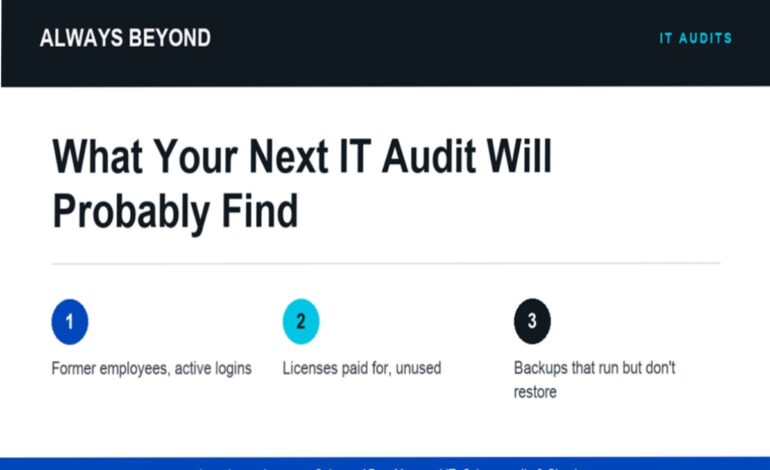

Every IT audit I’ve ever seen turns up the same quietly embarrassing thing: a login that still works for someone who hasn’t worked there in over a year. Not a hacker, not a breach, just Dave from accounting, who left eighteen months ago and, as far as the file server is concerned, is still very much on the team. It’s not dramatic. It’s just sitting there, mildly humiliating, waiting to be noticed. That’s usually the whole story with a proper IT audit: less a cyberattack thriller, more like finally cleaning out a garage you’ve been avoiding.
I say this as someone who has sat through enough of these reviews to stop being surprised by them. The findings are rarely exotic. They’re small, cumulative, and slightly humbling, which is exactly why business owners put off looking for them. Nobody schedules an afternoon to discover that the company is paying for forty software licenses and using twelve. Nobody wants to learn that the backup job has been quietly failing since March, technically running, technically producing a file, but a file that would not actually restore anything if you needed it to. These aren’t hypothetical scare stories. They are the ordinary residue of a business growing faster than its housekeeping.
Here’s the pattern worth noticing: none of this happens because anyone was careless in a single moment. It happens because IT access and infrastructure accumulate the way clutter does, one reasonable decision at a time. Someone got admin rights for a project that ended two years ago and nobody remembered to take them away. A vendor was granted remote access for a one-time job and the door was never closed. Each decision made sense on its own. The audit is just the first time anyone adds them all up.
The former employee problem deserves its own paragraph, because it’s the most common finding and the most avoidable one. Offboarding a person from payroll is a checklist. Offboarding them from every system they ever touched, the CRM, the shared drive, the VPN, the random tool the marketing team signed up for on a free trial and never cancelled, is not a checklist most businesses actually have. So the access lingers. Most of the time it’s harmless. Occasionally it isn’t, and that’s the entire argument for checking rather than assuming.
Licensing is the audit’s second favorite discovery, and it’s the one that annoys owners the most, because it’s pure waste with no upside. Software renews itself quietly in the background while the person who requested it moves teams, or leaves, or simply stops using the tool. A year later there’s a line item nobody can explain and nobody wants to be the one to cancel, in case it turns out someone secretly still needs it.
Then there’s backup integrity, which is the finding that should worry people more than it usually does. A backup that runs is not the same thing as a backup that works. The only way to know the difference is to actually try restoring from it, and most businesses have never done that, not once, because it’s tedious and there’s always something more urgent on the list. An audit forces the question before a server failure or a ransomware attempt forces it for you, at a much worse time to be learning the answer.
There’s a fourth category worth mentioning, because it’s the one that catches even careful owners off guard: the tools nobody officially approved. A department signs up for a scheduling app, a file-sharing service, a chat tool, because it solved a problem that week and nobody thought to loop in whoever handles the company’s technology. Multiply that by every department, every year, and an audit routinely turns up a dozen small services quietly holding company data, none of them patched, monitored, or even remembered by the people who could shut them down if something went wrong. It’s not reckless behavior. It’s just what happens when convenience and oversight grow at different speeds.
None of this requires a business to be large or complicated. Smaller companies drift into these gaps just as easily as bigger ones, sometimes faster, because there’s no dedicated person whose entire job is to notice. Calgary-based Always Beyond builds this kind of review into ongoing IT support for exactly that reason: the value isn’t the audit as a one-time event, it’s catching the drift before it becomes a headline.
If you’ve never had one done, ask yourself honestly whether you’d bet money that every former employee’s access has actually been shut off. Most owners hesitate before answering. That hesitation is the whole reason the audit exists.