
Incremental Model in Software Engineering Explained
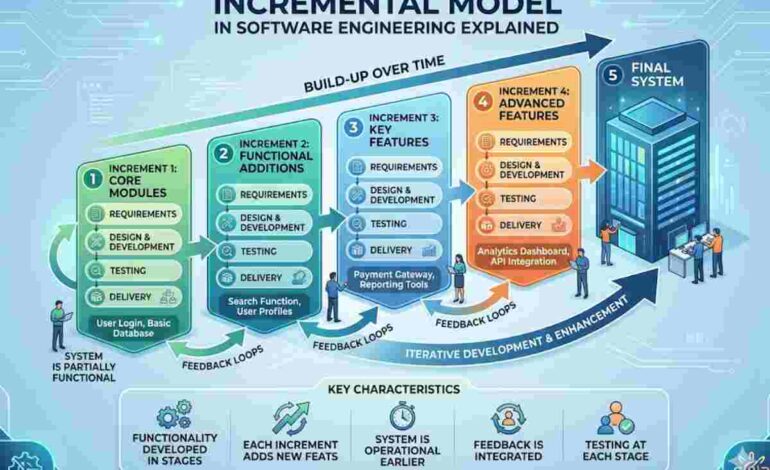

The incremental model in software engineering remains a software development approach where the system remains designed, implemented, and tested in small pieces called increments. Each increment adds new functionality to the previous working version until the full product remains completed.
This model helps teams deliver working software faster, gather user feedback early, and reduce development risks compared to traditional linear models.
Incremental Model in Software Engineering
Software development projects often require flexibility, faster delivery, and continuous improvement. Traditional approaches that build the entire system at once can delay feedback and increase risks.
The incremental model in software engineering solves this problem by breaking the software development lifecycle into multiple smaller releases, known as increments. Each increment includes planning, design, coding, and testing, resulting in a partially functional product that evolves with every iteration.
This approach remains widely used in modern software development because it allows teams to deliver value earlier, respond to changing requirements, and improve software quality through continuous testing.
What Is the Incremental Model?
The incremental model remains a software development methodology in which the product remains designed, implemented, and tested incrementally until the final product remains completed.
Instead of building the entire system at once, the software remains developed through multiple development cycles, where each cycle produces a working module or feature.
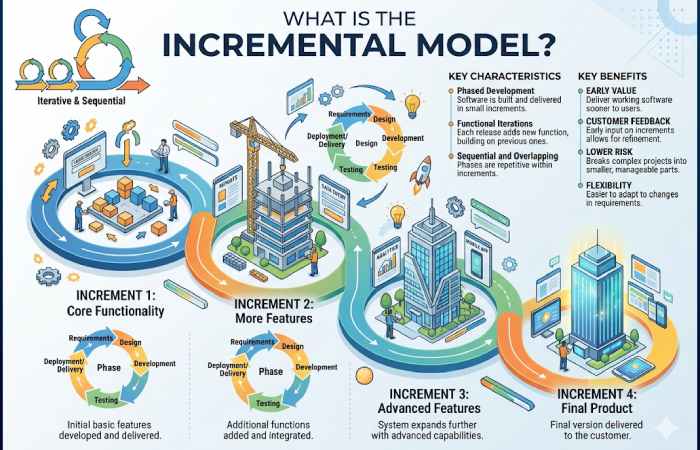
Key Characteristics
- Development remain divided into small increments
- Each increment delivers new functionality
- Early increments provide core system features
- Later increments add advanced features
- Users can test and provide feedback early
How the Incremental Model Works
| Phase / Step | Description | Key Activities | Typical Cost Range | Resource / Learning Link |
| Requirement Analysis | The overall system requirements are gathered and divided into smaller modules that can be developed in increments. | Requirement gathering, feasibility analysis, feature prioritization | $1,000 – $10,000 | https://www.geeksforgeeks.org/software-engineering/software-engineering-incremental-process-model/ |
| System Architecture Design | A high-level architecture for the entire system is created to ensure that future increments integrate smoothly. | System design, architecture planning, module structuring | $2,000 – $20,000 | https://www.scaler.com/topics/incremental-model-in-software-engineering/ |
| Increment Planning | Developers decide which features will be included in the first increment and subsequent releases. | Feature prioritization, sprint planning, release roadmap | $1,000 – $8,000 | https://www.atlassian.com/agile/project-management |
| Development (Coding) | The selected increment is implemented by developers and integrated with previously developed modules. | Coding, module integration, feature implementation | $5,000 – $80,000 | https://www.ibm.com/topics/software-development |
| Testing | Each increment is tested to ensure it works correctly and does not affect previous functionality. | Unit testing, integration testing, bug fixing | $2,000 – $25,000 | https://www.guru99.com/software-testing.html |
| Deployment / Release | The completed increment is deployed so users can start using the new functionality. | System release, configuration, monitoring | $1,000 – $15,000 | https://aws.amazon.com/devops/what-is-devops/ |
| User Feedback & Improvement | Feedback from users is collected and used to improve future increments and add new features. | Feedback analysis, performance monitoring, feature improvements | $500 – $10,000 | https://www.productplan.com/glossary/user-feedback/ |
| Next Increment Development | The next set of features is developed and integrated until the full system is completed. | Continuous development, updates, testing | $5,000 – $100,000+ | https://www.coursera.org/articles/software-development-life-cycle |
Example of Incremental Model
Consider the development of an online shopping platform.
Increment 1
Basic features:
- User registration
- Login system
- Product browsing
Increment 2
Additional features:
- Shopping cart
- Product search
- Wishlist
Increment 3
Advanced features:
- Payment gateway
- Order tracking
- Notifications
Each stage delivers a working system, improving the product step by step.
Types of Incremental Model in Software Engineering
| Type of Incremental Model | Description | Typical Project Cost Range | Best Use Case | Resource / Learning Link |
| Staged Delivery Model | The system is delivered in planned stages, where each stage releases a functional version of the software. Each increment adds new features until the final product is complete. | $5,000 – $100,000+ depending on software complexity | Web applications, enterprise software, SaaS platforms | https://www.geeksforgeeks.org/software-engineering/software-engineering-incremental-process-model/ |
| Parallel Development Model | The system is divided into multiple subsystems developed simultaneously by different teams, reducing overall development time. | $20,000 – $500,000+ for large systems | Large-scale systems, enterprise platforms, banking systems | https://www.scaler.com/topics/incremental-model-in-software-engineering/ |
| Rapid Application Development (RAD) – Incremental Variant | A fast development approach where components are built in parallel and integrated quickly, enabling rapid prototyping and frequent releases. | $10,000 – $200,000 depending on scope | Startup apps, mobile apps, prototypes | https://www.geeksforgeeks.org/software-engineering/difference-between-rad-model-and-incremental-model/ |
| Iterative-Incremental Model | Combines incremental development (new features added) with iteration (continuous improvement) after each release. | $15,000 – $300,000+ | Agile software products, cloud apps, SaaS | https://www.scaler.com/topics/incremental-model-in-software-engineering/ |
| Evolutionary Incremental Model | Software evolves through multiple versions, starting with a basic product and expanding with new modules over time. | $20,000 – $400,000+ | Large evolving systems, AI platforms, enterprise tools | https://en.wikipedia.org/wiki/Evolutionary_database_design |
Advantages of the Incremental Model
The incremental model offers several benefits for software development teams.
- Early Working Software
Users receive functional software early, which allows real-world testing and validation.
- Reduced Risk
Breaking development into smaller parts reduces the risk of total project failure.
- Easy Testing and Debugging
Since each increment is small, issues are easier to detect and fix.
- Faster Time-to-Market
Companies can release core features earlier and update later.
- Better Customer Feedback
Users can provide feedback after each increment, improving the final product.
Disadvantages of the Incremental Model
Despite its advantages, this model also has limitations.
- Requires Good Planning
The overall architecture must remain carefully designed before development begins.
- Integration Challenges
Combining increments can sometimes create compatibility issues.
- Higher Initial Design Effort
System architecture must support future expansion.
- Not Ideal for Small Projects
For very small applications, the incremental model may add unnecessary complexity.
When to Use the Incremental Model
The incremental model works best in the following situations:
- Large and complex systems
- Projects requiring early product releases
- Software with changing requirements
- Systems where features can remain developed independently
- Projects requiring continuous customer feedback
When Not to Use It
Avoid this model when:
- Requirements are extremely small
- The system architecture cannot support modular development
- The project requires strict linear development
Incremental Model vs Other SDLC Models
| SDLC Model | Description | Development Approach | Typical Project Cost Range | Best Use Cases | Resource / Learning Link |
| Incremental Model | Software is developed and delivered in small functional increments, where each release adds new features until the system is complete. | Modular and staged development | $10,000 – $300,000+ | SaaS platforms, web apps, enterprise software | https://www.geeksforgeeks.org/software-engineering/software-engineering-incremental-process-model/ |
| Waterfall Model | A linear and sequential approach where each phase must be completed before moving to the next phase. | Sequential development | $5,000 – $200,000+ | Government systems, regulated industries, small structured projects | https://www.geeksforgeeks.org/software-engineering/waterfall-model/ |
| Agile Model | Software is built using short iterative cycles (sprints) with constant feedback and collaboration. | Iterative and flexible | $20,000 – $500,000+ | Startups, mobile apps, cloud software, SaaS products | https://www.atlassian.com/agile |
| Spiral Model | Combines iterative development with risk management, focusing on identifying and mitigating risks early. | Risk-driven iterative approach | $50,000 – $1,000,000+ | Large complex systems, aerospace, banking software | https://www.geeksforgeeks.org/software-engineering/spiral-model/ |
| V-Model (Verification & Validation Model) | An extension of the waterfall model where testing occurs at every development stage. | Sequential with parallel testing | $15,000 – $250,000+ | Healthcare systems, embedded systems, safety-critical software | https://www.geeksforgeeks.org/software-engineering/software-engineering-v-model/ |
| RAD (Rapid Application Development) | Focuses on rapid prototyping and quick releases with strong user involvement. | Fast prototyping approach | $10,000 – $150,000+ | Startup apps, prototypes, small web platforms | https://www.geeksforgeeks.org/software-engineering/rapid-application-development-model-rad/ |
| DevOps Model | Integrates development and operations for continuous integration, testing, and deployment. | Continuous delivery and automation | $50,000 – $500,000+ | Cloud platforms, enterprise software, large SaaS systems | https://azure.microsoft.com/en-us/resources/cloud-computing-dictionary/what-is-devops |
Real-World Applications of Incremental Development
Many modern applications follow incremental development principles.
Software Examples
- Mobile applications
- Web platforms
- Enterprise software systems
- SaaS products
- Cloud-based platforms
Large companies often release feature updates incrementally instead of rebuilding entire systems.
Best Practices for Using the Incremental Model
To maximize success, software teams should follow these practices.
Prioritize Features Carefully
Develop core functionalities first.
Maintain Strong System Architecture
Ensure the design supports future increments.
Perform Continuous Testing
Testing should occur in every increment.
Gather User Feedback
Use feedback to improve later releases.
Monitor Integration
Ensure new modules integrate smoothly with existing components.
Common Mistakes to Avoid
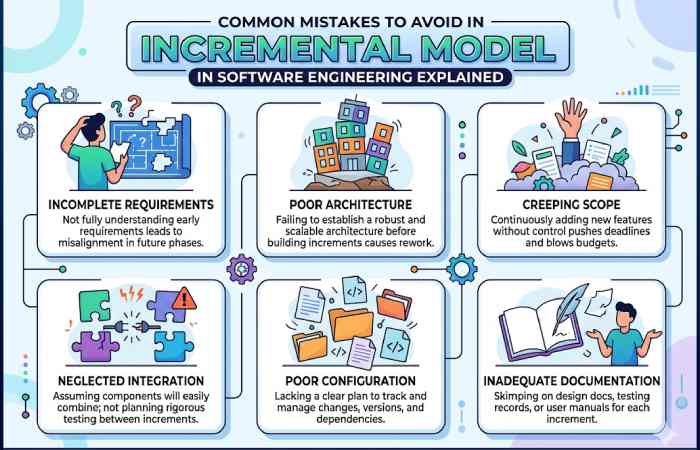
Some teams struggle with incremental development due to common errors.
- Poor architectural planning
- Ignoring user feedback
- Releasing increments without testing
- Developing features in the wrong order
- Overcomplicating small projects
Avoiding these mistakes ensures smoother development.
FAQs
What are the phases of the incremental model?
The main phases include:
- Requirement analysis
- System design
- Implementation
- Testing
- Deployment
These phases repeat for each increment.
What is the difference between incremental and iterative models?
- Incremental model: Adds new functionality in each release
- Iterative model: Improves existing functionality through repeated cycles
Many modern development frameworks combine both approaches.
Is the incremental model part of Agile?
While not strictly Agile, the incremental model shares similarities with Agile methods such as progressive delivery and continuous feedback.
What is the biggest advantage of the incremental model?
The biggest advantage is early delivery of working software, which allows testing, feedback, and faster improvements.
Final Conclusion
The incremental model in software engineering is an effective development methodology that delivers software in smaller, manageable pieces. By releasing functional increments, teams can reduce risks, gather early user feedback, and accelerate time-to-market.
This approach is particularly useful for large or evolving software projects where flexibility and continuous improvement are essential. When implemented with strong architecture and testing practices, the incremental model can significantly improve the success rate of modern software development projects.